Illinois voters deliver Democratic wave, reshaping state and federal power
Joliet and Will County residents contributed to a historic night that saw Democrats seize control of the U.S. Senate and House while retaining the Illinois governorship.
By Harper Collins ·
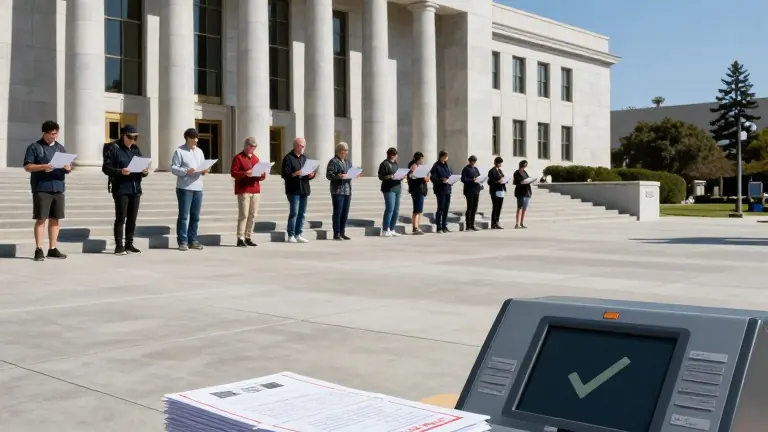
Residents across Joliet, Naperville, Bolingbrook, Orland Park, Tinley Park, and Downers Grove cast their ballots Tuesday between 6 a.m. and 7 p.m., participating in a decisive midterm cycle that has fundamentally altered the political landscape of Illinois and the nation. The final tallies indicate a significant shift in power, with Democratic candidates securing major victories in federal and state races that will influence policy decisions affecting local schools, transportation, and economic development for years to come.
In the race for the open U.S. Senate seat in Illinois, the Democratic candidate emerged as the victor, adding to a national trend where the party claimed seven previously Republican-held seats. This result ensures that Illinois will have a Democratic voice in the upper chamber of Congress, a position that will be critical as the new session convenes in January. The victory aligns with the broader national outcome where Democrats achieved a majority in the Senate, holding at least 54 seats compared to the Republican 44.
The outcome in the Illinois governor’s race solidified Democratic control over the executive branch of the state. Incumbent JB Pritzker, who faced challengers from the Republican, Green, and Independent parties, retained the office. With the governorship and the U.S. Senate seat both in Democratic hands, the state has a unified leadership structure that can more effectively push legislative agendas through the statehouse. This control extends to the state legislature, where Democrats won a plurality of state legislative chambers nationwide, including in Illinois, providing the legislative backbone to support the governor’s priorities.
Locally, the election results reflect a strong Democratic performance in Will County and the surrounding suburbs. The U.S. House races in the state saw Democrats capitalize on the national wave, picking up at least 43 House seats nationally, with a significant number of those gains occurring in Illinois districts. This shift means that the congressional delegation for the region will be dominated by Democrats, who are now poised to lead oversight investigations and control the appropriations process. For Joliet residents, this translates into a Congress that is more likely to support federal funding for infrastructure and education projects in the area.
National results confirmed a wave election against the president’s party, with Republicans suffering a net loss of at least seven Senate seats and 42 House seats. This level of loss places the 2026 midterm in the top 20% of election years in terms of seat swings against the president’s party. The defeat has immediate consequences for the Trump administration, which faces a Congress where Democrats hold the majority in both chambers. This new balance of power is expected to intensify scrutiny of executive actions, particularly in areas such as education and defense.
Democrats in Congress are already preparing to use their new majorities to challenge specific presidential policies. Rep. Bobby Scott of Virginia, the top Democrat on the House Committee on Education and the Workforce, indicated plans to investigate the dismantling of the U.S. Education Department. This oversight will likely affect how federal funds are distributed to schools in Joliet and other Illinois communities. Sen. Elizabeth Warren of Massachusetts also called for accountability regarding the administration’s education agenda, signaling a broader Democratic strategy to use investigative powers to check executive authority.
The shift in power also impacts the balance of state government trifectas, where Democrats won a majority of governorships for the first time since before the 2010 elections. In Illinois, the retention of the governor’s office by Pritzker and the election of a Democratic senator create a cohesive political front. This unity is expected to streamline the process of passing state-level bills that address local concerns, such as transit improvements and housing development in the Chicago suburbs. The new state legislature, now controlled by Democrats, will have the capacity to enact these changes without the gridlock that often occurs in divided governments.
Voters in the region also had the opportunity to decide on various state and local measures that vary by county. While specific local results for individual municipalities in Will County were part of the broader state tally, the overall trend favored Democratic candidates and measures aligned with their platforms. This outcome suggests that the electorate in Joliet and its neighboring towns prioritized continuity in state leadership and a strong voice in the federal government. The election also marked the first time since the 2010s that Democrats have held a majority of governorships, highlighting a sustained shift in voter preference across the state.
The national implications of the Illinois results are significant, as the state’s large electoral college and congressional delegation contribute to the overall Democratic majority. The new Congress is expected to focus on key issues such as healthcare, climate change, and economic policy, all of which have direct impacts on the local economy. For businesses and residents in the Joliet area, the change in congressional leadership may bring new opportunities for federal grants and regulatory changes that could affect local industries. The shift also means that Illinois will have a stronger advocate in the Senate for state-specific issues, such as transportation funding for the region’s major highways.
As the new Congress convenes in January, the focus will turn to the implementation of the Democratic agenda. The party’s control of both chambers allows for a more aggressive legislative approach, potentially leading to the passage of bills that were previously stalled by Republican majorities. For Illinois, this means a more active role in national policy discussions, with state leaders able to leverage their positions to secure resources for the region. The election results serve as a clear mandate for the new leadership, setting the stage for a new era of governance that will shape the future of Joliet and the state for the coming decade.