Día de los Muertos: From Mesoamerican ritual to national holiday
What began as a pre-Columbian observance in Mexico is now a two-day event held in cities from New York to Seattle, with roots in both Indigenous tradition and the 1970s Chicano movement.
By Harper Collins ·
Day of the Dead begins the morning after Halloween.
The holiday, known as Día de los muertos, runs from Nov. 1 to Nov. 2. It is not a second Halloween. It is a separate, older celebration with its own calendar, its own logic, and its own rules about who comes back and when.
According to History.com, the roots of the holiday stretch back roughly 3,000 years to pre-Columbian Mesoamerican rituals that honored the dead. Over centuries, those rituals blended with Roman Catholic tradition. The result is a two-day event with a specific structure. On Nov. 1, the gates of heaven are said to open for the spirits of children, who rejoin their families for 24 hours. On Nov. 2, the spirits of adults return.
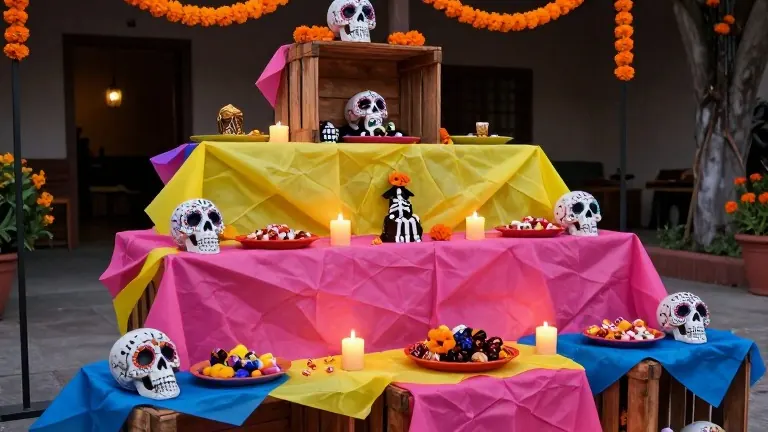
Participants expect the dead to eat, drink, dance and play music with the living. Families build altars, called ofrendas, and fill them with photos, candles, candy and the favorite foods of the departed. Cemeteries are decorated with plastic marigold garlands and painted sugar skulls in pinks, yellows, blues and greens. Marigolds are known as the flower of the dead. Their scent, according to tradition, guides the souls back to the land of the living.
The holiday was long centered in Mexico, Guatemala, Brazil and parts of Ecuador. There, bakers made sugar skulls and sweet bread of the dead. Artists cut elaborate paper designs for altars. Some families stayed up all night at burial sites, keeping vigil to greet a returning spirit.
The celebration crossed into the United States through the Chicano movement. Regina Marchi, a journalism and media studies professor at Rutgers University, said Chicano artists in the 1970s brought Mexican ritual into American public life. She described the effort as an act of political resistance and cultural pride. The term Chicano, per Rutgers, is a self-identifying label used by Mexican Americans who see themselves as politically active on social justice issues.
Word spread. Today, San Antonio and Los Angeles are considered the largest and most established destinations for the holiday. But events are also held in New York City, Fort Lauderdale, Chicago, Phoenix, San Francisco, Seattle and Anchorage. The celebration has moved from a regional tradition into a national calendar event, though its meaning, to participants, is still specific: a festive but sincere remembrance of the dead, not a costume party.