Arizona canal faces 47% water cut, a risk engineers predicted in the 1960s
Policymakers ignored decades-old warnings to secure backup water sources, leaving the Central Arizona Project vulnerable to a steep reduction in its Colorado River allocation.
By Harper Collins ·
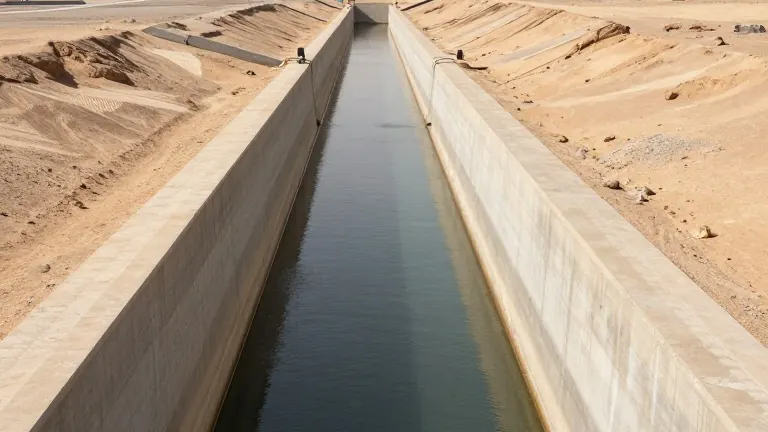
The Central Arizona Project will face a 47% reduction in its annual water allocation this year. The cut is part of a new federal plan designed to manage a Colorado River system that is drying up under record low reservoir levels. Arizona, Nevada, and the CAP itself have filed legal challenges against the measure.
The crisis is not a sudden development. When the 336-mile canal system was authorized in the 1960s, its architects explicitly warned that the project would not function without additional water sources. They predicted that allocations would drop sharply in the coming decades. Those warnings were largely ignored for sixty years.
The system was designed to deliver stable water to the growing cities of Phoenix and Tucson. Floyd Dominy, the commissioner of the Bureau of Reclamation at the time, forecast that available supplies would be more than halved between 1990 and 2030. He attributed the decline to increased usage in upstream states, including Colorado, New Mexico, Utah, and Wyoming. While his specific reasoning was incomplete, his prediction of lower flows proved accurate.
Congressman Mo Udall, a key Democratic supporter from Arizona, testified in 1968 that the canal required "augmentation" to survive. He defined augmentation as adding outside water supplies to the river. The most prominent proposal involved connecting the Colorado River system to the Columbia River in the Pacific Northwest. Senators from that region were so concerned about the impact on their own water that they included a clause in the legislation. That clause barred the federal government from studying such a transfer for ten years after the law passed.
Despite the political momentum, the proposed fixes never materialized. Tom McCann, a former deputy general manager for the CAP, said there was no willingness to spend money on a problem that had not yet arrived. "There was no willingness to spend money to address a future problem that wasn't here yet, and that I think people were not sure whether it was going to materialize or not," McCann said. The agency continued to study desalination and pipeline options, but cost and political hurdles prevented implementation.
The failure to act created a structural gap in the system. Rich Weissinger, who worked for the CAP for nearly 30 years, noted that the infrastructure is robust. "We have lots of people, lots of industry, lots of municipalities that depend on a stable water source, and that's what CAP can bring," Weissinger said. However, the physical reliability of the pumps and turbines cannot compensate for the shrinking volume of water available to pump.
Brad Udall, a senior water research scientist at Colorado State University and son of Mo Udall, argues that the original proponents deserve some forgiveness. He suggests that the optimism of the post-World War II era influenced their thinking. "The 1968 idea was we could build our way out of anything," Udall said. "We could engineer our way out of every crisis. We're smart. We're rich. The world's our oyster."
Udall believes his father and uncle, Stewart Udall, who served as secretary of the Interior from 1961 to 1969, prioritized getting the canal built over solving long-term supply issues. "They figured, like many humans do, we'll do some of the hard work later," Udall said. The complex negotiations that followed a long legal battle between Arizona and California left proponents eager to finalize the project. They chose to defer difficult decisions regarding future water security.
Chuck Podolak, former director of the Water Infrastructure Finance Authority of Arizona, suggests that promising augmentation allowed policymakers to avoid a harder conversation. He noted that farms and ranches account for roughly three quarters of all Colorado River water use. "I have a strong thesis that this is a way to avoid saying Phoenix is going to grow at the expense of agriculture," Podalak said. Building new infrastructure, such as desalination plants, allowed leaders to delay the political reality that urban growth would require reducing agricultural water rights.