Sahel Drone War: 15 Ukrainian Specialists Reportedly Train Tuareg Rebels in Mali
A CNN investigation suggests Kyiv is helping separatists fight Russian-backed forces, a move that complicates Ukraine's diplomatic standing in West Africa.
By Anthony Foster ·
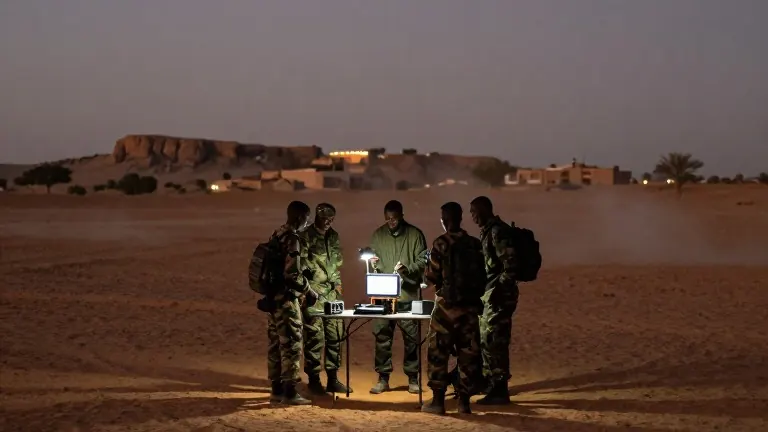
For residents of northern Mali, the conflict with the military government in Bamako has taken on a new dimension. According to an investigation published by CNN in September, approximately 15 Ukrainian drone specialists are currently supporting Tuareg rebels in the region. Their shared objective is to weaken the Malian government and its Russian allies, a development that signals the Russia-Ukraine war may be extending into the Sahel.
The presence of these specialists has raised questions about the scope of Kyiv’s involvement. CNN reported that the Ukrainians provided drone training, operational planning, and remote support for missions. While the network news outlet’s findings are specific, they have not been independently verified by other major media organizations. The details suggest a structured effort to improve the capabilities of local fighters rather than a direct deployment of Ukrainian troops into combat roles.
Strategic analysts see a clear motive behind the alleged support. Marta Oliynyk-D'omochko, coordinator of the African Studies Program at the National University of Kyiv-Mohyla Academy, stated that Ukraine’s primary interest is to weaken Russia’s influence globally. She argued that reducing Moscow’s military footprint would also diminish the economic opportunities arising from that influence. This view is shared by Irina Filatova, a professor emeritus at the University of KwaZulu-Natal, who finds the support plausible, though she noted she lacks independent evidence to confirm the specific operations.
The suspicions surrounding this involvement date back to July 2024. At that time, Ukrainian military intelligence service (HUR) spokesperson Andriy Yusov said Tuareg rebels had received necessary information for an ambush on Russian Wagner fighters near Tinzaouaten. While Ukraine denied direct involvement, the attack resulted in heavy losses for Wagner paramilitaries and Malian troops. More recently, Kyrylo Budanov, former head of HUR and now chief of staff to President Volodymyr Zelenskyy, posted on X on September 7 that Ukrainian intelligence protects interests worldwide, from Russia to Africa, in the burning desert sands.
The political context of the alliance is complex. The Tuareg separatist Azawad Liberation Front (FLA) cooperates with the Jama'at Nusrat al-Islam wal Muslimeen (JNIM), a jihadist group affiliated with al-Qaeda. While the FLA seeks self-determination for northern Mali, JNIM aims to impose strict Islamic rule. Oliynyk-D'omochko described the relationship as a tactical arrangement, noting that the FLA is not seeking to replace the government in Bamako but is focused on autonomy. This situational alliance against a common enemy carries risks, as Kyiv could face accusations of indirectly supporting Islamist fighters through its cooperation with the FLA.
Mali, along with Niger and Burkina Faso, has accused Ukraine of undermining their territorial integrity. In September, Mali’s Foreign Minister Abdoulaye Diop stated at the United Nations that Ukraine was providing clear and open support to terrorist groups. The three Sahel nations, all ruled by military governments, have severed diplomatic relations with Kyiv and deepened ties with Russia. Russia, which replaced the Wagner Group with the Africa Corps in 2025, continues to expand its activities in the region. Ulf Laessing, former head of the Sahel program at the Konrad Adenauer Foundation, noted that the Africa Corps still uses Syria and Libya as transit points for operations on the continent.
The extent of Ukrainian involvement remains officially unclear. Deutsche Welle reached out to the HUR for comment, asking whether personnel had been deployed to Mali and if the political leadership had approved the mission. An HUR spokesperson said the agency might provide information at a later date. Until then, the alleged cooperation stands as a potential shift in how the war is fought beyond Europe, with small teams of specialists training local forces to challenge Russian-backed forces in the Sahel.
Source: Deutsche Welle