
AI and Art: A Hebrew University professor argues the creative process still matters
A new study in AI & Society suggests that while generative tools bypass technical training, the value of art lies in the personal and cultural changes it produces.
By Harper Collins ·
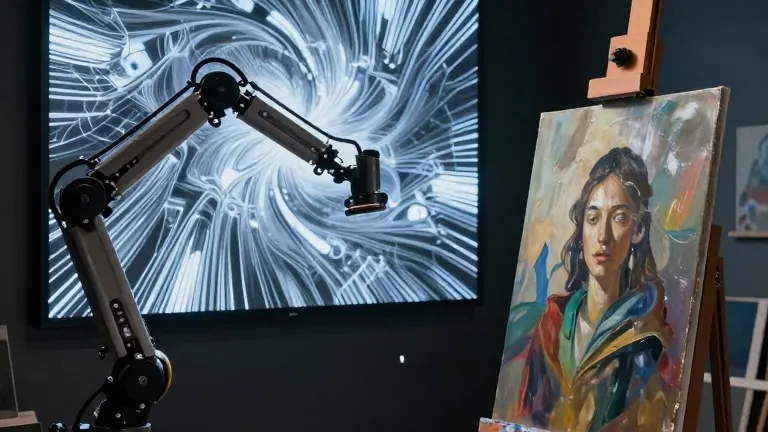
A new academic paper argues that artificial intelligence is not destroying human art but is changing how society defines creative value.
The study, published in the journal AI & Society, was written by Amit Zoran, a professor at the Hebrew University of Jerusalem. Zoran leads the Hybrid Design Lab in the university's School of Computer Science and Engineering. He holds degrees from Ben-Gurion University, MIT, and the Bezalel Academy of Arts and Design. His research focuses on connecting computational technologies with traditional human crafts.
Zoran introduces a concept he calls the decoupling thesis. This idea states that AI allows people to produce sophisticated artistic works without undergoing the years of personal development traditionally required for such tasks. A person can now generate detailed illustrations without learning to draw or compose music without mastering an instrument. Zoran notes that for centuries, creating art meant going through a process of learning and changing as a person. Today, technology allows for sophisticated output without that specific journey.
The paper shifts the focus from whether AI-generated works qualify as art to whether the process of creating them holds inherent value. Zoran argues that the significance of creativity lies in the experiences that shape artists, audiences, and cultures, not just the finished product. He suggests that AI opens new possibilities for how humans experience and understand the world. The study highlights projects that use technology to engage participants with nature through smell, taste, sound, and AI-generated music.
In an interview, Zoran said the real potential of AI is not just to help produce more content but to open new possibilities for engagement. He believes the future of creativity depends on what people discover and become through the process, rather than what they make. He noted that debates often focus on authorship and artifacts, but the impact on the artist or culture is more important. Zoran compared the shift to the Industrial Revolution, stating that AI is the first technological revolution in this context. He said, "I have faith in humanity, which finds a way to proceed."
The research suggests that educational and cultural institutions might place greater value on the creative process rather than exclusively on finished products. Artists could use time saved by AI to experiment and develop richer experiences. Zoran emphasized that while AI can bypass technical training, it cannot replace the transformative experiences that give creativity its meaning. The paper concludes that as production becomes more accessible, the focus should move toward exploration and meaningful experiences.